by Amanda Radke in BEEF Daily
Feb. 17, 2014
A Wisconsin dairy producer takes HSUS CEO Wayne Pacelle to task for his organization’s deceitful practices.
Over the weekend, I spoke at the annual meeting of the Wisconsin Cattlemen’s Association. On our way back to South Dakota from Wisconsin Dells, we stopped in Minnesota to visit my husband Tyler’s family. We were visiting with his grandparents when we both noticed a pair of winter gloves lying on the table. Eblazoned on them were the words, “Humane Society of the United States (HSUS).”
Immediately, Tyler asked his grandma where she got those gloves. Worried that the gloves were a reward for her $19.99 donation to HSUS to save homeless dogs and cats (a fallacy that HSUS claims in its advertising), we were somewhat relieved to hear she had received the gloves from a neighbor. My mother-in-law had explained to Tyler's grandma how HSUS is an adversary to animal agriculture, and Tyler’s grandma had dutifully tried to obscure the “United States” part of the gloves with a black permanent marker.
What I found disturbing, however, was that the neighbor who had given Tyler's grandma the gloves is from an active hog-producing family. Apparently there are still well-intentioned farmers and ranchers out there who unknowingly donate money to HSUS, the very organization that seeks to end animal agriculture.
full story at link: http://beefmagazine.com/blog/continue-spread-word-hsus-wolf-sheep-s-clothing
Showing posts with label HSUS fundraising. Show all posts
Showing posts with label HSUS fundraising. Show all posts
Monday, February 17, 2014
Monday, April 23, 2012
Wednesday, August 24, 2011
HSUS: D-D-Dreadful Charity Practices

Three times a year, the venerable American Institute of Philanthropy (which runs CharityWatch.org) analyzes publicly reported information from charities and issues a report card grading how well these organizations spend their money. Unlike other charity analysts, AIP digs past the face-value data to get a more accurate measure of how effective a charity is. And in its latest report, AIP gives the deceptively named Humane Society of the United States a “D” grade—yet again.
Last year, AIP gave HSUS a “D” grade—twice—due to the animal rights group’s lackluster performance (to put it mildly) in using donors’ contributions. Even PETA has a “C-plus” grade. (AIP must not dock points for hypocritically killing thousands of animals a year.)
AIP finds that HSUS spends up to 49 cents to raise every dollar—quite inefficient fundraising. Additionally, AIP finds that HSUS spends as little as 49 percent of its budget on programs. Full story at Consumer Freedom
Wednesday, April 20, 2011
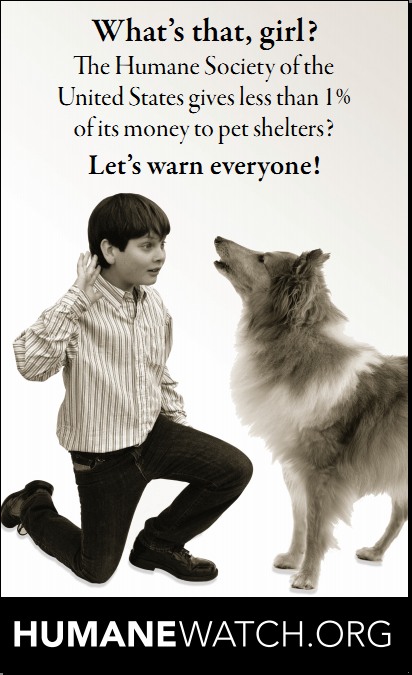
New HumaneWatch Billboard Hits Times Square
HumaneWatch does it again - great billboard. Click on the link for a view.
Washington, DC – Today HumaneWatch.org, a project of the nonprofit Center for Consumer Freedom (CCF), unveiled a new billboard in New York’s Times Square criticizing the Humane Society of the United States (HSUS) for its deceptive fundraising practices. Despite most Americans’ belief to the contrary, HSUS is not a national umbrella group that represents community-based humane societies, and it shares less than one percent of its income with underfunded pet shelters at the local level.
The billboard is located at Seventh Avenue, between 48th and 49th Streets. Its unveiling coincides with HSUS President Wayne Pacelle’s scheduled April 21 New York City appearance to promote his new book, The Bond. The HumaneWatch ad features a young boy shocked to hear from the family pet that HSUS gives less than one percent of its money to hands-on pet shelters.
“HSUS is an animal rights group that uses heart-wrenching images of dogs and cats to guilt the American public into donating. But it’s sharing less than one percent of the proceeds with the hands-on shelters that actually care for these animals,” said Rick Berman, CCF’s Executive Director. “HSUS’s millions support a huge staff of lawyers and lobbyists, bloated executive pension plans, exorbitant fundraising expenses, and bankroll an animal rights agenda that attacks modern farming.”
HSUS raised $97 million in 2009, mostly from Americans who thought their donations would filter down to local pet shelters. According to Opinion Research Corporation polling, 59 percent of Americans falsely believe HSUS “contributes most of its money to local organizations that care for dogs and cats.”
“The Humane Society of the United States is a humane society in name only,” continued Berman. “Americans can really make a difference to animals in their communities by donating and volunteering at their local shelters.”
The Center for Consumer Freedom is a nonprofit watchdog organization that informs the public about the activities of tax-exempt activist groups. It is supported by American consumers, business organizations, and foundations.
Visit HumaneWatch to learn more
Washington, DC – Today HumaneWatch.org, a project of the nonprofit Center for Consumer Freedom (CCF), unveiled a new billboard in New York’s Times Square criticizing the Humane Society of the United States (HSUS) for its deceptive fundraising practices. Despite most Americans’ belief to the contrary, HSUS is not a national umbrella group that represents community-based humane societies, and it shares less than one percent of its income with underfunded pet shelters at the local level.
The billboard is located at Seventh Avenue, between 48th and 49th Streets. Its unveiling coincides with HSUS President Wayne Pacelle’s scheduled April 21 New York City appearance to promote his new book, The Bond. The HumaneWatch ad features a young boy shocked to hear from the family pet that HSUS gives less than one percent of its money to hands-on pet shelters.
“HSUS is an animal rights group that uses heart-wrenching images of dogs and cats to guilt the American public into donating. But it’s sharing less than one percent of the proceeds with the hands-on shelters that actually care for these animals,” said Rick Berman, CCF’s Executive Director. “HSUS’s millions support a huge staff of lawyers and lobbyists, bloated executive pension plans, exorbitant fundraising expenses, and bankroll an animal rights agenda that attacks modern farming.”
HSUS raised $97 million in 2009, mostly from Americans who thought their donations would filter down to local pet shelters. According to Opinion Research Corporation polling, 59 percent of Americans falsely believe HSUS “contributes most of its money to local organizations that care for dogs and cats.”
“The Humane Society of the United States is a humane society in name only,” continued Berman. “Americans can really make a difference to animals in their communities by donating and volunteering at their local shelters.”
The Center for Consumer Freedom is a nonprofit watchdog organization that informs the public about the activities of tax-exempt activist groups. It is supported by American consumers, business organizations, and foundations.
Visit HumaneWatch to learn more
Wednesday, February 24, 2010
Getting to Know HSUS
By Rick Jordahl | Tuesday, February 23, 2010
Layer by layer, the facade of the Humane Society of the United States is being peeled back revealing the group’s far-reaching objectives. The world is learning that at the center is an animal rights group with much more on its agenda than saving dogs and cats.
Australian wine maker, Casella Wines, learned the hard way. After the company’s commitment to donate $100,000 was roundly criticized by many consumers of the wine makers’ Yellow Tail wine, the company reevaluated their commitment to HSUS.
In exchanges with the Animal Agriculture Alliance, Casella has decided that “future support for animal welfare will go to organizations specifically devoted to hands-on care, such as rescue, sterilization, feeding, or disaster assistance.”
Casella Wines’ wish to aid and support animals seems genuine and the company’s misdirected donation, while unfortunate, is understandable. HSUS fund-raising tactics excel at generating donations from those who are unaware of the group’s extensive agenda.
More layers of the HSUS exterior will be peeled back with last week’s launch of the Web site www.HumaneWatch.org . Sponsored by the Center for Consumer Freedom, the site’s objective is to educate the public about what HSUS is and what it is not. CCF is a non-profit organization supported by over 100 companies and thousands of individual consumers.
“People mistake HSUS for an animal welfare group that manages pet shelters,” says David Martosko, CCF director of research. “Part of the objective of HumaneWatch.org is to correct that misperception.”
Full story at Pork Magazine link
Layer by layer, the facade of the Humane Society of the United States is being peeled back revealing the group’s far-reaching objectives. The world is learning that at the center is an animal rights group with much more on its agenda than saving dogs and cats.
Australian wine maker, Casella Wines, learned the hard way. After the company’s commitment to donate $100,000 was roundly criticized by many consumers of the wine makers’ Yellow Tail wine, the company reevaluated their commitment to HSUS.
In exchanges with the Animal Agriculture Alliance, Casella has decided that “future support for animal welfare will go to organizations specifically devoted to hands-on care, such as rescue, sterilization, feeding, or disaster assistance.”
Casella Wines’ wish to aid and support animals seems genuine and the company’s misdirected donation, while unfortunate, is understandable. HSUS fund-raising tactics excel at generating donations from those who are unaware of the group’s extensive agenda.
More layers of the HSUS exterior will be peeled back with last week’s launch of the Web site www.HumaneWatch.org . Sponsored by the Center for Consumer Freedom, the site’s objective is to educate the public about what HSUS is and what it is not. CCF is a non-profit organization supported by over 100 companies and thousands of individual consumers.
“People mistake HSUS for an animal welfare group that manages pet shelters,” says David Martosko, CCF director of research. “Part of the objective of HumaneWatch.org is to correct that misperception.”
Full story at Pork Magazine link
Tuesday, January 19, 2010
HSUS: Another Disaster, Another Payday
From the Center for Consumer Freedom January 18, 2010
The earthquake that left Haiti in ruins last week is an unspeakable tragedy that calls for the support of humanitarians around the world to rescue and rebuild. But some “charities” may not have the most honest of goals. Human rights journalist Anai Rhoads writes that the Humane Society of the United States (HSUS) and other groups are engaging in deceptive fundraising by overstating the number of animals in need:
HSUS also claimed that there are companion animals. “…a large stray dog population, an untold number of companion animals.” This is really tough sell, in an area so poor that scanning trash for food was the norm. It would be utter suicide for the more than 80 percent of those are poor in the country to house and feed a companion animal.
Rhoads also points out that also much of the livestock and pet populations in Haiti were ravaged following strong storms in 2008. Another observer in Haiti reports that he didn’t notice any stray cats just six days before the quake. As Rhoads puts it, HSUS is raising money to help “a mass number of animals, which don’t seem to exist.”
Not that such technicalities have historically mattered to HSUS. If a boatload of donations is left over when it leaves Haiti, the money can be commingled with the other tens of millions in assets HSUS already has in the bank. From there, it can be spent on anything HSUS wants, from PETA-inspired lobbying to putting farmers out of business. Just don’t expect too much of it to go to hands-on dog and cat shhelters.
This latest situation is another chapter in HSUS’s history of questionable fundraising ploys.
Full story ....
The earthquake that left Haiti in ruins last week is an unspeakable tragedy that calls for the support of humanitarians around the world to rescue and rebuild. But some “charities” may not have the most honest of goals. Human rights journalist Anai Rhoads writes that the Humane Society of the United States (HSUS) and other groups are engaging in deceptive fundraising by overstating the number of animals in need:
HSUS also claimed that there are companion animals. “…a large stray dog population, an untold number of companion animals.” This is really tough sell, in an area so poor that scanning trash for food was the norm. It would be utter suicide for the more than 80 percent of those are poor in the country to house and feed a companion animal.
Rhoads also points out that also much of the livestock and pet populations in Haiti were ravaged following strong storms in 2008. Another observer in Haiti reports that he didn’t notice any stray cats just six days before the quake. As Rhoads puts it, HSUS is raising money to help “a mass number of animals, which don’t seem to exist.”
Not that such technicalities have historically mattered to HSUS. If a boatload of donations is left over when it leaves Haiti, the money can be commingled with the other tens of millions in assets HSUS already has in the bank. From there, it can be spent on anything HSUS wants, from PETA-inspired lobbying to putting farmers out of business. Just don’t expect too much of it to go to hands-on dog and cat shhelters.
This latest situation is another chapter in HSUS’s history of questionable fundraising ploys.
Full story ....


Subscribe to:
Posts (Atom)

 Posts
Posts